Tin products factory

Study request

mashroo3k Consulting offers a feasibility study for a tin products manufacturing factory project in Saudi Arabia, ensuring the highest profitability and the best payback period. This is achieved through detailed studies of the Saudi market size, analysis of local and international competitors’ strategies, and the provision of competitive pricing offers.

Capital

rate of return

Recovery period Third year

Tin Products Factory Project Description

Tin Products Factory Project Description

mashroo3k Company for Economic Consulting provides investors wishing to invest in a tin products factory project in Saudi Arabia, A range of specialized feasibility studies. It is based on up-to-date databases specific to the Saudi market. What makes a project successful. and maximize profitability. and the best payback period.

Foil products are increasingly popular. Foil plates and utensils are widely used in hotels, restaurants and hospitals, and are an essential commodity for parties and major events, due to their ability to retain heat for a relatively longer period, in addition to being easy to dispose of.

 Tin products factory output

Tin products factory output

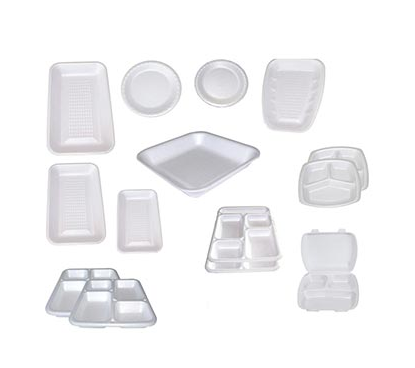
  • Round foam plates
  • Small, medium and large foam boxes
  • Meal boxes
  • Small and family pizza boxes
  • Fast food dishes
Why mashroo3k ?

Why mashroo3k ?

  • Mashroo3k has over 11 years of experience in preparing feasibility studies, market research, and providing a wide range of consulting services, including administrative, economic, financial, and others.
  • Mashroo3k has offices in 7 international branches, located in Saudi Arabia, the UAE, Egypt, Qatar, Oman, Yemen, and Iraq, in addition to its agents in China, Singapore, and other countries.
  • Mashroo3k has provided over 8000 services and feasibility studies, helping thousands of clients achieve their investment goals.
  • Mashroo3k’s services are accredited and trusted by all financial institutions and entities in the Middle East.
  • Mashroo3k’s service coverage extends to 35 countries across all continents.
  • Mashroo3k is a member of over 100 prestigious international institutions specializing in market research and business management.
  • Mashroo3k’s team consists of 350 consultants with extensive knowledge of economic sector indicators and opportunities. Thanks to the diversity of their expertise, they ensure effective solutions and strategies.
  • Mashroo3k is contracted with over 10,200 suppliers in 35 countries to support projects logistically with production lines, raw materials, machinery, equipment, and similar resources.
  • Mashroo3k possesses a vast database that enhances the accuracy of its predictions and analyses, as well as its ability to manage risks effectively.
  • Project features
  • Study contents
  • Sector indicators
  • The Project is an Investment Opportunity
مؤشرات القطاع
  • Focus on the quality of raw materials.
  • A highly skilled and competent team.

  • Focus on general cleanliness of the factory.
  • Supervision by a management team with precision and discipline in work.
  • Utilizing advanced technology in manufacturing and packaging.
  • The project will produce plates with high quality and efficiency.
  • Commitment to maintaining product quality during packaging and wrapping.
Executive Summary
  • About the project
  • Financial Indicators
  • Rationale for the project
  • Government Investment Incentives for the Project

  • Target Markets
  • Project Indicators and Final Results
Study of the project’s services/products.

  • Project description and all its products/services.
  • Project advantages and production requirements.
Market size study.
  • Understanding distribution channels.
  • Consumer behavior, preferences, and tendencies.
  • Competitors’ products or services, along with their strengths and weaknesses.
  • Market nature and its characteristics.
  • The demand size for the offered product or service.
  • The available share of the target market
  • The optimal marketing strategy.
Risk assessment study.
  • Risk identification.
  • The impact of risks on the project.
  • Risk prevention methods.
Technical study.
  • A detailed description of the project’s products, expected production capacity, and determination of investment costs.
  • Determining the required electricity and water capacity.
  • Determining the project’s labor requirements.
  • Determining the project’s requirements
  • Calculating construction and building costs.

  • Calculating the total capital.
  • Determining the annual operating costs.
  • Determining the amount of working capital.
Financial study.

  • Total investment costs required for the project.
  • Organizing cash flow statements, income statements, and the balance sheet for the first ten years of operation.
  • Determining the Expected Annual Revenue of the Project Based on the Specified Operational Capacities.
  • The optimal financing structure for the project in light of investors’ capabilities and financing conditions.
  • The project’s financial indicators and sensitivity analysis.
Organizational and administrative study.

  • Project Workforce
  • Organizational structure.
  • Job responsibilities.

المشروع كفرصة استثمارية

Saudi Arabia has paved the way for development through its ambitious Vision 2030, which aims to diversify the economy, advance non-oil sectors, and increase the contribution of the private sector to the GDP. This goal cannot be achieved without the growth of industry and mining, as they serve as fundamental pillars of major economies. The Kingdom is committed to increasing their contribution to its GDP by approximately 15%.
When discussing the industrial sector in Saudi Arabia, it is essential to acknowledge that it is not a recent development but has deep roots dating back to the discovery of oil in the late 1930s. Over the decades, the Kingdom has spared no effort in advancing its industries. This commitment led to the establishment of the Industrial Development Fund (1974), the Royal Commission for Jubail and Yanbu (1975), and later, the Saudi Basic Industries Corporation (SABIC) in 1976. The contributions of these institutions and the programs they have implemented have played a crucial role in the growth and modernization of the industrial sector.
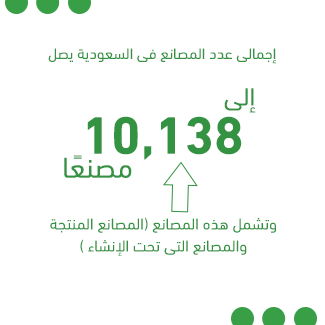
As a result of years of dedicated efforts, the number of factories in Saudi Arabia has now exceeded 10,000.
At Mashroo3k, we firmly believe in the importance of the industrial sector and its role in driving economic progress. Below, we present key industry indicators to provide potential investors with a clear and informed perspective.

  • The total number of factories in Saudi Arabia now reaches 10,138, including both operating factories and those under construction.
  • The building materials industry holds the largest share of factories in the Kingdom, with 2,016 factories, followed by the metal industry with 1,705 factories.
  • The number of food factories in the Kingdom reaches 1,445 factories.
  • The plastic and rubber industry has 1,317 factories.
  • The number of operating factories, according to the latest statistics, reaches 8,258 factories.
  • The number of licensed workers in these operating factories reaches 967,119 workers.

  • The capital of these operating factories reaches 1,214,762,000,000 SAR.
  • The Riyadh region holds 39.4% of the total operating factories, with 3,255 factories.
  • The Eastern Province holds 41.4% of the total capital of operating factories, amounting to 503,448,000,000 SAR.
  • The percentage of medium-sized factories is estimated at 46.9% of the total number of operating factories.
  • The number of factories under construction is estimated at 1,880 factories.
  • According to the latest available statistics, the number of licensed workers in factories under construction is 84,342 workers, and their capital is estimated at 67,264,000,000 SAR.
  • Food products account for the largest number of factories under construction, with 249 factories (13.4%), followed by rubber and plastic products with 222 factories (11.9%).

  • Small establishments account for 72.4% of the total number of factories under construction
  • The largest number of factories under construction is located within the geographical scope of Riyadh; Riyadh alone accounts for 43.9% of the total number of these factories, followed by the Eastern Region with a percentage exceeding 19.2%, and then the Makkah Al-Mukarramah Region with a percentage of 9.6%.
مؤشرات المشروع
  • Today, Saudi Arabia is working on developing 14 industrial cities and zones with a total area of 34 million km².

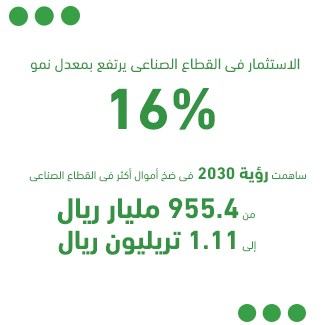
  • Investment in the industrial sector is growing at a rate of 16%.
  • Vision 2030 has contributed to increased investments in the industrial sector. Before the vision, investments in the sector amounted to approximately 955.4 billion SAR, rising to 1.11 trillion SAR by the end of 2020.
  • The Ministry of Industry and Mineral Resources provides various services to investors through the “Sanai” electronic platform, such as industrial licensing, customs exemption (allowing investors to exempt machinery, raw materials, and spare parts from customs duties), labor endorsement, and chemical clearance.
  • The Saudi Industrial Development Fund offers many incentive programs, Like this: (Horizons, Competitiveness, Localization, Renewables). The fund is credited with expanding the industrial sector, offering up to 75% of the project’s value as a loan in some economically promising regions.

    Like this: (Hail, Tabuk, Al-Jawf, etc.) for a period of up to 20 years as a maximum financing period. It is worth noting here that the amount of money disbursed from the fund is estimated at 121.1 billion riyals until the end of December 31, 2020.


By sector


Capital (in millions)


rate of return


Keywords: :

Tin products factory Tin products factory in saudi arabia Tin Products Factory Project
  • Similar projects
  • Previous work